Bentley Brooklands
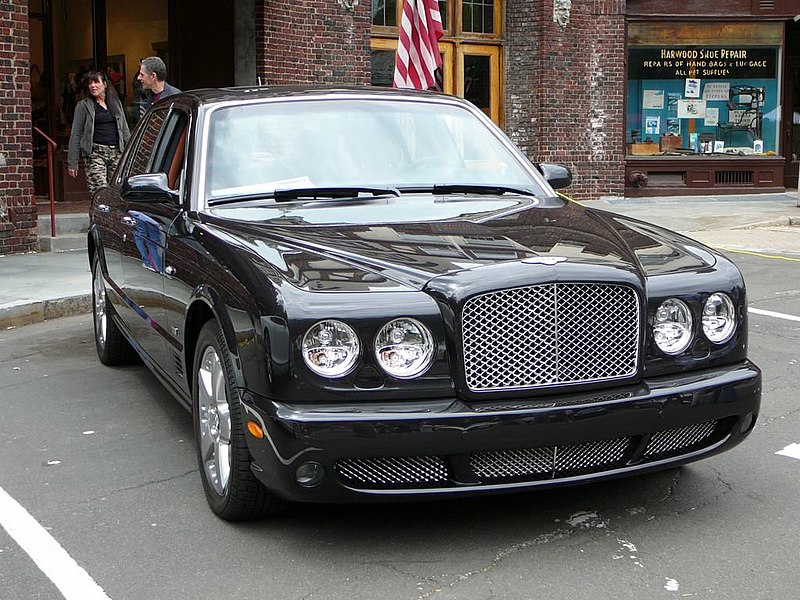
The Bentley Brooklands is a two-door coupe and four-seater derivative of Azure convertible. Therefore, technically it has nothing to do with the models developed since the brand is owned by Volkswagen (the coupe Continental GT, the convertible Continental GTC saloon and the Continental Flying Spur).

Bentley only intends to produce 550 units of Bentley Brooklands; deliveries to customers will not begin until the first half of 2008.

Unlike the Continental GT, the Bentley Brooklands is a coupe with two doors and silhouette of three volumes.

According to Bentley, there are features in the design taken from the work they did on some old coach Bentley models. One of those cited is that glass for glasses is visually far from the trunk (glass for glasses 'floating' call it). The responsibility for the design of the Bentley Brooklands is Dirk van Braeckel.

As usual in Bentley, and especially in this case due to limited production, customers can choose from a wide range of colors and materials for the interior. One feature of Bentley Brooklands is that the roof is in one piece lengthwise trail with bright elements, which reaches the rear seats. Standard wheels are 20 ", partly because of the diameter of the discs you need.

Technically has elements of Bentley with eight-cylinder engine and rear traction, when Bentley and Rolls-Royce were in the same group, the latest Bentley have twelve cylinders and traction total.
 In the case of Bentley Brooklands, the turbocharged V8 engine of 6.7 litres of engine capacity reaches 530 hp.

This power level is a big increase compared with the engine of Azure (457 hp) and lowest in relation to the Arnage (500 hp), but not much relative to their engine capacity if we bear in mind that this is a turbocharged engine.
The engine of Bentley Brooklands is the most powerful V8 that has made for a Bentley model range and reaches 1,050 Nm of maximum torque.
On behalf of Bentley Brooklands is taken from some of the first permanent circuits, which was located in Surrey (England) and was inaugurated in 1907; Bentley won victories in competition at this circuit during years 20 and 30.
Read More
Bentley only intends to produce 550 units of Bentley Brooklands; deliveries to customers will not begin until the first half of 2008.
Unlike the Continental GT, the Bentley Brooklands is a coupe with two doors and silhouette of three volumes.
According to Bentley, there are features in the design taken from the work they did on some old coach Bentley models. One of those cited is that glass for glasses is visually far from the trunk (glass for glasses 'floating' call it). The responsibility for the design of the Bentley Brooklands is Dirk van Braeckel.
As usual in Bentley, and especially in this case due to limited production, customers can choose from a wide range of colors and materials for the interior. One feature of Bentley Brooklands is that the roof is in one piece lengthwise trail with bright elements, which reaches the rear seats. Standard wheels are 20 ", partly because of the diameter of the discs you need.
Technically has elements of Bentley with eight-cylinder engine and rear traction, when Bentley and Rolls-Royce were in the same group, the latest Bentley have twelve cylinders and traction total.
 In the case of Bentley Brooklands, the turbocharged V8 engine of 6.7 litres of engine capacity reaches 530 hp.
This power level is a big increase compared with the engine of Azure (457 hp) and lowest in relation to the Arnage (500 hp), but not much relative to their engine capacity if we bear in mind that this is a turbocharged engine.
The engine of Bentley Brooklands is the most powerful V8 that has made for a Bentley model range and reaches 1,050 Nm of maximum torque.
On behalf of Bentley Brooklands is taken from some of the first permanent circuits, which was located in Surrey (England) and was inaugurated in 1907; Bentley won victories in competition at this circuit during years 20 and 30.


 Even given its simple design, it is clear that Audi Q7 inaugurates new trends. The typical Audi dynamism is reflected in the broad curve of the roof, and in particular the relationship between the broad surface of the body and slimmer crystal. The dynamic curve of the front section and the powerful rear-mounted with its elegantly tilted, shape silhouette of a coupe.
 The same characteristics of the Audi formal style are the high belt line and dynamic line, which define the side. The two-tone paint (optional) creates a contrast that provides a picture of an impact. There are eleven basic colors, three of which are intended exclusively to Audi Q7.


 The Audi A4 Cabriolet closed and open makes a good figure. The fully automated electro-hydraulic hood can be up to a speed of 30 km / h operation, an advantage not to be underestimated, for example, in city traffic, where a spontaneous stop is not always possible.
 Two advanced gasoline engines with direct fuel injection FSI Audi sets now in the new Audi A4 Cabriolet: the 188 kW / 255 hp 3.2 FSI V6 and turbo-charged two-litre four-cylinder 2.0 TFSI (power: 147 kW / 200 hp). They combine high performance with a spontaneous response of the accelerator and a high level of torque lying plateau. This is already known from the previous 1.8T with 163 hp (120 kW). The TDI offer to the serial start the six-cylinder 3.0 TDI with common-rail injection. The TDI engine makes the Audi A4 Cabriolet 171 kW (233 hp).

 A connection that convinced: The new two-litre four-cylinder provides 125 kW (170 hp) and 350 Nm output torque for dynamic jacking. It consumes the TT Coupe and The TT Roadster in the Middle only about 5.3 liters or 5.5 liters of fuel per 100 km - an unrivalled low value in the sports car segment.
 Since its 1989 debut, the TDI engines of the brand with the four ring the way for the successful efficiency technology in the world and also a trendsetter for the entire automotive industry. The triumph of diesel racing car Audi R10 TDI at the 24 Hours of Le Mans and in the American Le Mans Series has the potential of high technology impressively demonstrated.
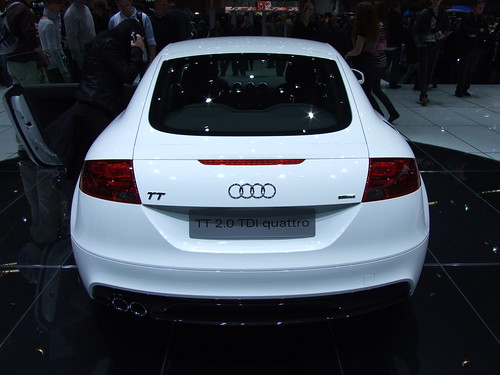 The Audi TT Roadster, with the permanent all-wheel drive Quattro equipped need for the standard sprint only about a tenth of a second longer, his head is 223 km / h. With consumption levels by 5.5 litres per 100 km - according to a CO2 emissions of only 144 g / km - shipping both outstanding examples of the success of the strategy of efficiency Audi.

 As with the previous two aggregate compensation reduce the vibration waves in the crank drive. The raw emissions of nitrogen oxides drop dramatically. The 2.0 TDI already met the limits of the future Euro 5 norm.


